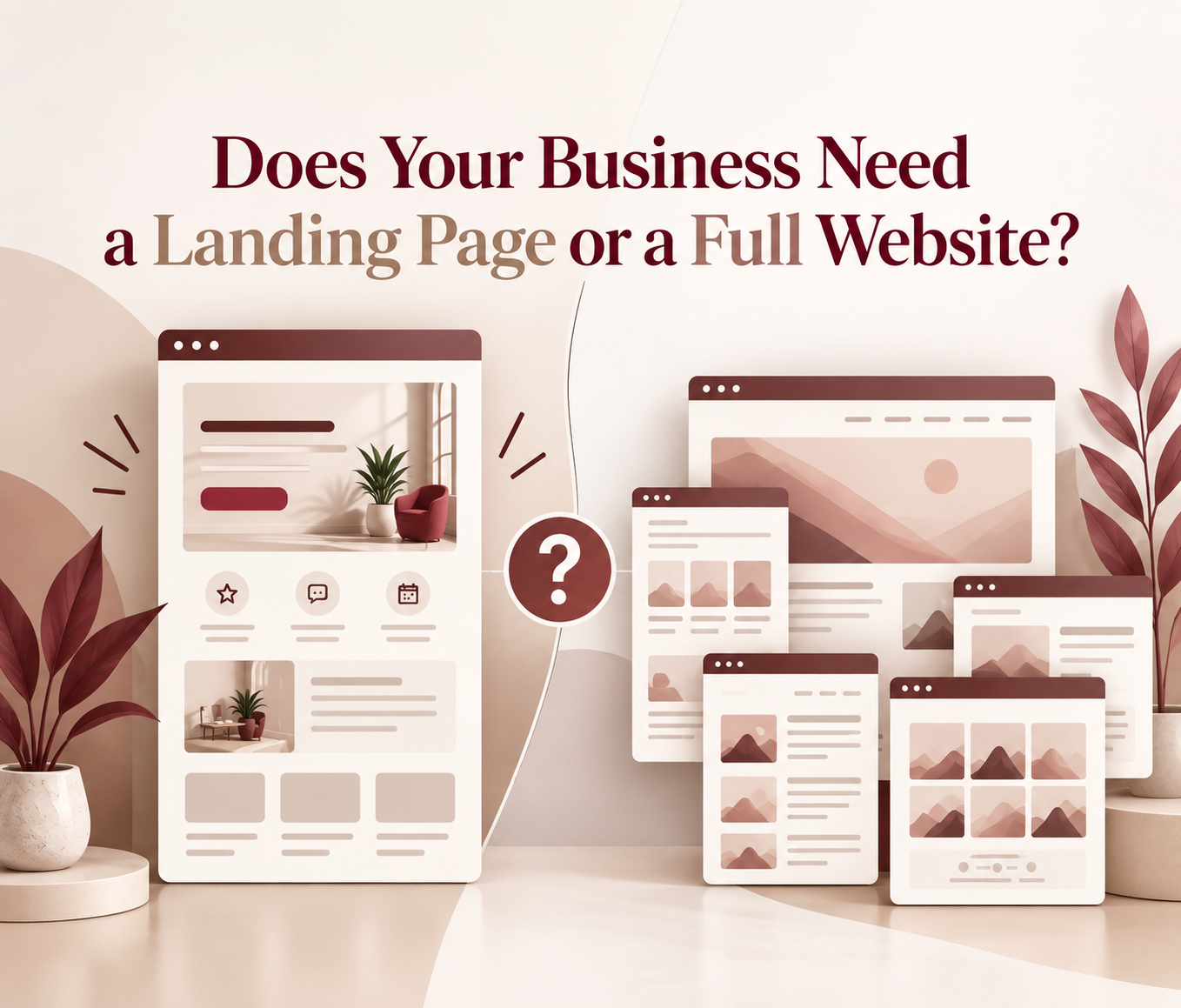
Does Your Business Need a Landing Page or a Full Website?
Does Your Business Need a Landing Page or a Full Website?
You’ve finally decided to build an online presence for your business.
You start researching, and within minutes, you find yourself facing two options that seem to come up everywhere:
Landing Page or Full Website?
A landing page is usually faster, simpler, and more affordable. A full website, on the other hand, gives you more space to showcase your business and services while building a stronger online presence in the long run.
So, do you really need a website with multiple pages? Or could one well-designed page do the job?
The answer depends less on the size of your business and more on one important question:
What do you want visitors to do when they land on your website?
Buy? Book? Send a message? Learn more about your business? Compare your services? Or discover you through Google?
Answering this question will make the decision much easier.
Do you have one service and One Goal?
Imagine you offer consulting services, and you want every person who visits your website to do one thing:
Book a consultation.
Do you really need Home, About, Services, Portfolio, Contact, and five other pages?
Probably not.
This is where the power of a Landing Page comes in.
Instead of spreading the visitor’s attention across multiple pages, you put everything they need to know into one clear journey:
Problem → Solution → Service → Why Choose You → Trust Signals → FAQs → Book
NowThe visitor doesn’t have to decide where to go next. The page guides them step by step toward the action you want them to take. This makes a Landing Page an excellent choice for a specific service, a single product, a course, an event, a limited-time offer, or even a new business that is just getting started.
The idea is simple:
One Offer. One Goal. One CTA.
If that describes your business, one page may be all you need right now.
Running Ads? Don’t Send Everyone to Your Homepage
Let’s say you launch an Instagram ad promoting your brand identity design service.
Someone sees the ad, likes the offer, and clicks.
Then what?
They land on your homepage.
Now they’re looking at website design, SEO, eCommerce stores, graphic design, About, Blog, Portfolio…
A few seconds ago, they were thinking about one thing:
“I need a brand identity.”
Now you’ve given them ten other things to think about.
This is why Landing Pages are commonly used with advertising campaigns.
You can create a Landing Page that focuses only on what the person clicked the ad for.
If the ad promotes a specific service, they land on a page dedicated to that service.
If the ad promotes an offer, they land on the offer page.
If the goal is to book an appointment, the entire page is designed to lead them toward that booking.
There is a clear connection between:
Ad → Landing Page → Desired Action
That’s much better than telling the visitor:
“Welcome to our website. Now go find the thing you saw in the ad.”
You Have Five Services? This Is Where One Page Starts Working Against You
Landing Pages are great when you have one thing you want visitors to focus on.
But what if you offer:
Website design, eCommerce stores, SEO, brand identity, and graphic design?
Technically, you can put everything on one page.
The problem starts when you try to explain everything on that same page.
Someone looking for an eCommerce store doesn’t need to read through the details of your logo design service before reaching the information they actually want.
And someone interested in SEO may need completely different information from someone looking for website design.
This is where a full website becomes more than just a collection of pages. It becomes a way to organize information.
Instead of:
We offer Service A, B, C, D, and E…
Each service gets its own dedicated space.
Visitors can go directly to the service they’re interested in, read the relevant details, explore the information they need, and then take the appropriate action.
At the same time, someone who wants to learn more about the business can visit the About page. Someone who wants to see previous work can explore the Portfolio, while someone with questions can head to the FAQ or Contact page.
The more your visitors need to explore, the more valuable a full website becomes.
Want Google to Bring You Customers? The Decision Becomes Bigger Than Design
This is especially important if SEO is part of your strategy.
Let’s say you offer three services:
- WordPress Website Design
- WooCommerce Store Design
- SEO Services
If you put everything into one Landing Page, you’re asking a single page to cover three different topics in depth while trying to satisfy multiple search intents at the same time.
With a full website, you can create a strong, dedicated page for each service.
One page can focus on WordPress Website Design.
Another can focus on WooCommerce Stores.
And another on SEO Services.
Your blog can then support those service pages with useful content that answers the questions your target audience is searching for.
Instead of relying on a single page, you now have multiple pages that can act as different entry points to your website from search results.
And this is where one of the biggest advantages of a full website becomes clear:
You’re not just building a place to send customers. You’re building a place customers can find.
That doesn’t mean a Landing Page can’t appear on Google. It can. But by nature, a Landing Page is more focused and offers less room for expansion compared with a website built around organized service pages and content.
If organic traffic is an important part of your long-term strategy, you’ll likely need more than one page at some point.
Your Business Is Small Today… But What About Next Year?
It’s easy to choose a solution based only on what your business needs today.
But your website is a digital asset that should grow with your business.
Maybe you have one service right now.
Six months later, you have three.
Then you need to showcase your work.
After that, you start publishing articles.
Eventually, you want to add a booking system, an online store, or a section for your team.
Suddenly, the small page that was perfect in the beginning is trying to carry everything.
That’s why you shouldn’t only ask:
“What do I need right now?”
Also ask:
“Where is my business heading?”
If you’re testing an idea or launching a single service, starting with a Landing Page can be a smart decision.
But if you already have a clear plan for expansion, it may be better to build a foundation that allows your website to grow with your business.
The Short Answer
If you’re still unsure, use this simple rule:
Choose a Landing Page if you have:
One offer + a specific audience + one clear goal.
For example:
Launching a service, running an advertising campaign, booking consultations, event registrations, generating leads, or selling a specific product.
Choose a Full Website if you have:
Multiple services + more information + a need to build trust + SEO + a long-term growth plan.
Especially when potential customers need to explore your business before making a decision.
Don’t Choose Based Only on Price or Number of Pages
One common mistake is thinking about it this way:
One page = cheaper.
Full website = better.
Not necessarily.
If a Landing Page does everything your business needs, adding seven more pages won’t automatically make your online presence stronger.
You may simply end up with pages containing two or three sentences, or the same information repeated in different ways.
On the other hand, if your business offers several services and relies on Google to attract customers, choosing a single page just because it costs less could quickly become limiting.
So instead of asking:
“How many pages do I get for my budget?”
Ask:
“Which pages does the user actually need to reach the decision I want them to make?”
That question leads to a much better website.
Who Said You Have to Choose Just One?
Here’s the part that often gets overlooked:
Landing Pages and full websites are not competitors.
You may actually need both.
Let’s say your company has a full website with:
Home, About, Services, Portfolio, Blog, and Contact.
Then you decide to launch an advertising campaign for a new service.
Instead of changing your entire website or sending the ad traffic to your homepage, you can create a dedicated Landing Page for that campaign.
Your main website works to build your brand, provide information, support SEO, and give potential customers a complete picture of your business.
Meanwhile, the Landing Page has one job:
Turn campaign visitors into leads or customers.
For businesses that rely on multiple marketing channels, this can often be the best approach.
Your website is your business’s digital home.
Landing Pages are focused paths built for specific goals.
Before You Decide, Answer These Questions
If you can answer these questions, you’ll probably know which option makes more sense for your business.
- How many services do I offer?
One service may work perfectly with a Landing Page, while multiple services usually require better organization. - Where will my visitors come from?
If most visitors are coming from a specific ad campaign, a dedicated page makes a lot of sense. If you also want people to discover you through Google, think bigger. - What action do I want visitors to take?
The more focused and specific the action is, the stronger the case for a Landing Page. - Do customers need to research my business before they trust me?
In some industries, viewing previous work, learning about the company, and reading detailed information are essential parts of the buying decision. - Do I want to publish content in the future?
If blogging and SEO are part of your strategy, a full website gives you a stronger structure for growth. - Will the business expand?
Don’t build something today that you’ll need to completely replace a few months from now.
Can You Start With a Landing Page and Expand Later?
Absolutely.
In some cases, this is the most practical approach.
You don’t need to wait until you have enough content for ten pages before establishing your online presence.
You can start with one strong page that serves your current business needs and expand gradually:
Landing Page → Service Pages → About → Portfolio → Blog
However, there’s a difference between a page designed from the beginning with future growth in mind and a temporary page that needs to be completely rebuilt once your business expands.
If you already know growth is coming, it’s better to plan for it from the start.
Contact Me